

Custom prosthetic & orthotic services
Tailored to you and your lifestyle
Prosthetic limbs: who needs one and how they work

Prosthetic limbs restore mobility, independence and confidence for people who have lost an arm or leg through injury, illness, or congenital conditions. A prosthesis replaces the form and function of the missing limb, enabling walking, grasping, balance and everyday activities while also supporting long-term health and activity goals.
Why someone might need a prosthetic limb
Traumatic amputation (accident or injury)
Medical amputation due to vascular disease, infection or cancer
Congenital limb difference present at birth
Progressive conditions affecting limb function
How prosthetic limbs are manufactured
Manufacture combines clinical assessment, custom design and precision fabrication. The process begins with gait and functional assessment, followed by casting or 3D scanning of the residual limb to create an accurate socket fit. Prosthetists design the limb based on activity level and goals, select components and materials, and refine the device through iterative fitting and alignment sessions. Final finishing includes cosmetic covers and fine-tuning for comfort and performance.
Key components
Socket: The custom-moulded interface between the residual limb and the prosthesis; primary determinant of comfort and fit.
Suspension system: Methods to secure the prosthesis to the limb (suction, vacuum, liners, straps).
Pylon or frame: Structural support that connects the socket to the terminal device.
Terminal device: Foot or ankle unit for lower-limb prostheses; hand or specialised terminal device for upper-limb prostheses.
Knee joint (for transfemoral users): Mechanical or microprocessor-controlled joints that enable safe, efficient walking.
Features, technology and materials
Materials: Lightweight carbon fibre, titanium, aluminium and advanced plastics for durability and reduced weight.
Microprocessor knees and smart ankles: Sensors and processors that adapt to walking speed and terrain for smoother gait and improved safety.
Myoelectric and pattern-recognition control: Upper-limb systems that use muscle signals for intuitive hand and wrist movement.
Prosthetic liners and suspension innovations: Improve comfort, skin health and suspension reliability.
Activity-specific components: Running blades, waterproof feet, and specialised grips for vocational or sporting needs.
If you or someone you care for is considering a prosthetic limb, contact X-Tremity Prosthetics & Orthotics to book a consultation. Our experienced team provides individual assessment, evidence-based recommendations and personalised care to help you achieve your mobility goals.
Orthotic devices: AFOs, KAFOs, braces and insoles
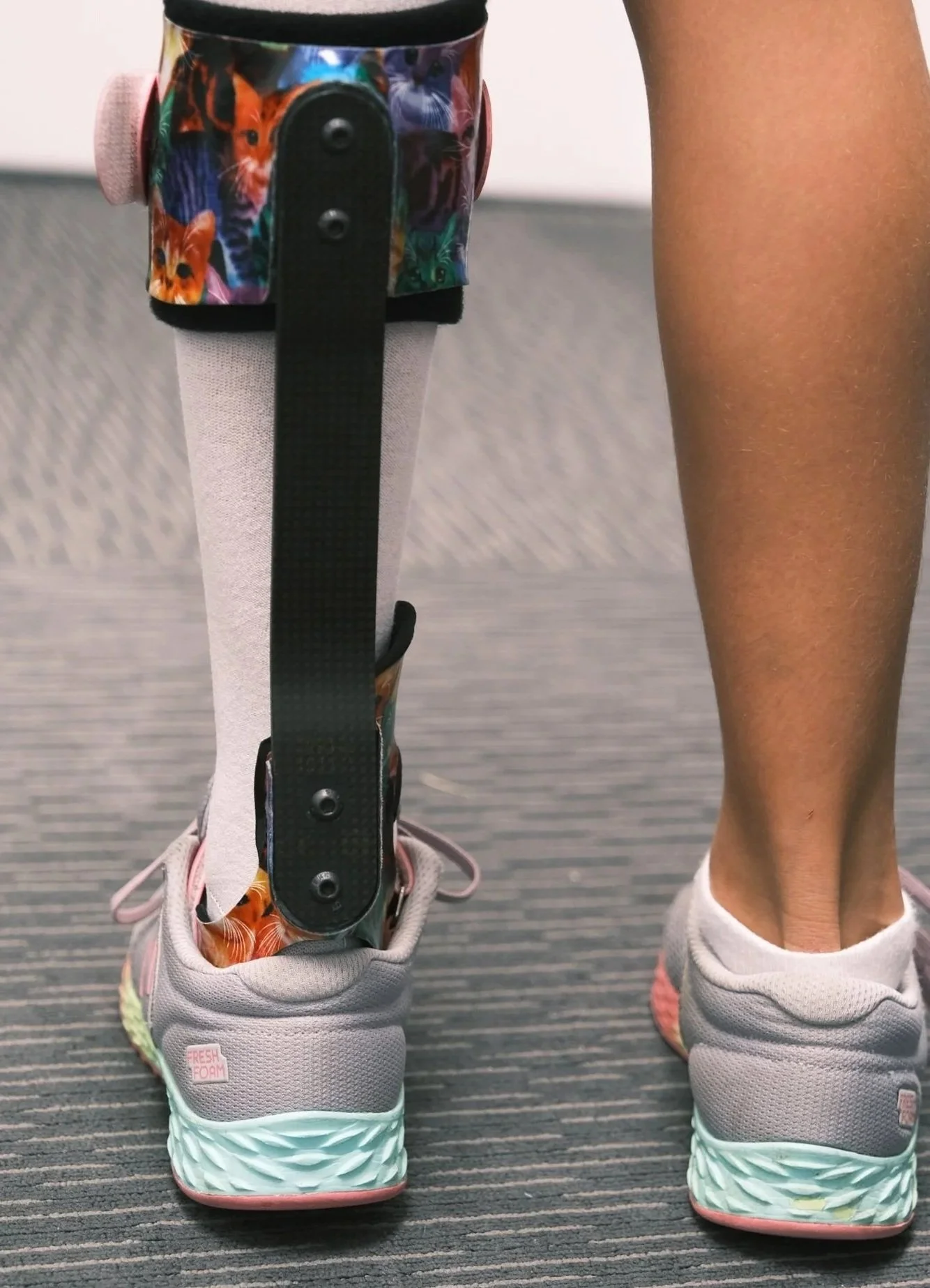
Orthotics play a vital role in restoring function, reducing pain and improving mobility for people with a wide range of musculoskeletal and neurological conditions. Orthotic devices include simple arch supports and custom insoles, ankle-foot orthoses (AFOs), knee-ankle-foot orthoses (KAFOs), knee braces, spinal orthoses and specialised foot orthoses. They’re designed to support, align, protect or correct the anatomy and to assist movement where muscles or joints are weak, unstable or painful.
Who might need an orthotic device?
People with flat feet, plantar fasciitis, or overpronation who benefit from arch supports or custom insoles.
Individuals recovering from stroke, cerebral palsy or peripheral nerve injuries who need AFOs to control foot drop and improve gait.
Patients with knee instability, ligament injuries or post‑op rehabilitation who use knee braces or KAFOs.
Those with spinal deformity, osteoarthritis or chronic back pain who require spinal orthoses for support and posture.
Anyone seeking pain relief, improved function or injury prevention during work, sport or daily activities.
How orthotics work
Orthoses work by redistributing forces, limiting harmful motion, aligning joints in a more favourable position and improving mechanical efficiency. Custom devices are prescribed after assessment of gait, posture, range of motion and strength. The orthotist translates that assessment into a device that can correct alignment, stabilise joints, absorb shock and assist limb advancement during walking.
How they assist people
Orthotics can reduce pain, prevent deformity, increase stability, improve balance and energy efficiency, and enable participation in daily activities and rehabilitation. For many users they are an alternative to surgery or a vital adjunct to therapy and exercise.
Components, technologies and materials
Modern orthotics combine traditional craftsmanship with advanced materials and technology. Common components include shells or struts, joints, straps, liners and footbeds. Materials range from carbon fibre and thermoplastics (lightweight, strong and mouldable) to EVA, silicone and specialised foams for cushioning and comfort. Technologies such as 3D scanning and CAD/CAM design allow precise customisation, while dynamic carbon components and microprocessor‑assisted joints provide energy return and adaptable support.
If you’d like personalised orthotic assessment or a custom device, contact X‑Tremity Prosthetics & Orthotics. Our experienced orthotists will assess your needs and recommend the most suitable solution to restore comfort and function.